
Key Takeaways
- An electric breast pump uses a motor to create repeated suction-and-release cycles that help express breast milk.
- Many models offer stimulation and expression modes to support different stages of pumping.
- Double electric pumps can express milk from both breasts simultaneously, potentially saving time.
- Correct flange sizing and comfortable suction are important for effective pumping.
- Electric pumps are convenient for frequent expressing, while manual pumps may be sufficient for occasional use.
An electric breast pump uses a motor to create rhythmic suction around the nipple, helping breast milk flow into a collection bottle or cup. Unlike manual pumps, electric models automatically generate suction, reducing the physical effort required to express milk.
For Malaysian parents preparing to return to work or share feeding responsibilities, an electric breast pump can make expressing milk more convenient.
But how exactly does it work, and is it worth buying? Here's what beginners should know before investing in one.
How Does an Electric Breast Pump Work?
An electric breast pump creates repeated suction-and-release cycles that help express milk from the breast into a collection container.
The motor powers a pump that creates suction at the breast shield, also called a flange. This gently draws the nipple into the flange tunnel, helping milk flow into a collection bottle or cup.
According to the US Food and Drug Administration (FDA), electric breast pumps use a motor powered by electricity or batteries to generate suction.
Electric breast pumps typically include these components:
|
Component |
Function |
|
Motor |
Powers the pump's suction |
|
Breast shield (flange) |
Fits over the nipple and surrounding breast tissue |
|
Valve or membrane |
Helps control suction or direct milk flow, depending on the design |
|
Tubing or air channel |
Transfers suction where required |
|
Collection bottle or cup |
Collects expressed breast milk |
Some wearable pumps have integrated designs that do not require separate external tubing.
What Happens During Pumping?
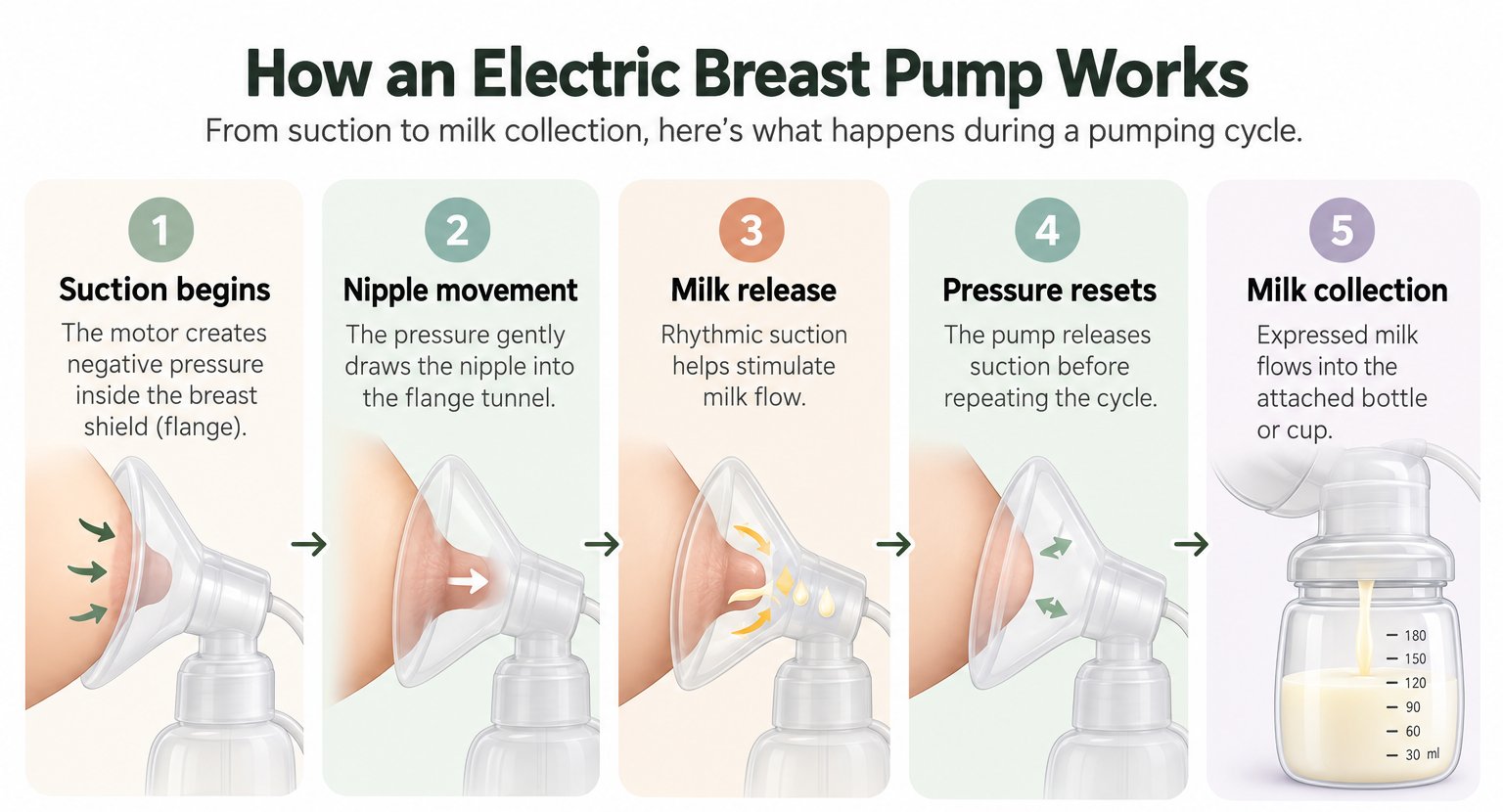
The process involves five stages:
- Suction begins: The pump creates negative pressure inside the breast shield.
- Nipple movement: The pressure gently draws the nipple into the flange tunnel.
- Milk release: Rhythmic suction helps stimulate milk flow.
- Pressure resets: The pump releases suction before repeating the cycle.
- Milk collection: Expressed milk flows into the attached bottle or cup.
Each suction-and-release sequence is called a pumping cycle.
Although different pumps use different technologies, their basic purpose remains the same: helping remove milk through controlled suction.
What Are Stimulation and Expression Modes?
Many electric breast pumps have two pumping modes designed to support different stages of milk expression.
1. Stimulation Mode
Stimulation mode commonly uses faster, lighter suction cycles to encourage the milk ejection reflex, also called let-down.
It is often used at the beginning of a pumping session before milk starts flowing consistently.
2. Expression Mode
Expression mode commonly uses slower, stronger suction cycles to support ongoing milk removal.
Once milk begins flowing, you can use expression mode if your pump offers it, adjusting the suction to a comfortable level. Some pumps switch modes automatically, and the timing of milk let-down varies between individuals.
|
Feature |
Stimulation Mode |
Expression Mode |
|
Purpose |
Encourage milk let-down |
Support continued milk removal |
|
Suction pattern |
Faster, lighter cycles |
Slower, stronger cycles |
|
When to use |
Often at the beginning |
Usually once milk begins flowing |
|
Main focus |
Stimulation |
Milk collection |
Important: Stronger suction doesn't necessarily produce more milk. Excessive suction may cause discomfort or nipple injury.
How Do You Use an Electric Breast Pump?
Using an electric breast pump becomes easier once you understand the basic process.
Step 1: Prepare Your Equipment
Wash your hands thoroughly before pumping.
Ensure that the breast shield, collection bottle and other milk-contact components are clean, dry and correctly assembled.
Follow the manufacturer's cleaning and sanitising instructions, taking extra precautions if your baby is younger than 2 months, premature or has a weakened immune system.
Check that valves, membranes and tubing connections are securely fitted.
Step 2: Position the Breast Shield
Place the flange against your breast, keeping your nipple centred inside the tunnel.
The flange should fit comfortably, allowing your nipple to move freely without excessive rubbing, pinching or pulling.
If your nipple rubs against the tunnel or too much breast tissue is drawn inside, you may need a different flange size.
Step 3: Start With Low Suction
Switch on the pump using its lowest comfortable suction setting.
Begin with stimulation mode if available, then move to expression mode when milk starts flowing.
NHS guidance on expressing breast milk explains that milk may take a few minutes to start flowing.
Increase suction gradually if needed, but never to the point of pain.
Step 4: Continue Pumping Comfortably
Monitor your comfort and milk flow throughout the session.
A single electric pump expresses milk from one breast at a time, while a double electric pump allows simultaneous expression.
There is no universal pumping duration suitable for everyone. The time required depends on your milk flow, pumping goals and individual response.
Step 5: Finish and Clean the Pump
Once you've finished:
- Switch off the motor.
- Allow the suction to release before removing the flange.
- Cap the milk container, label it with the date and time, and store it safely.
- Disassemble and clean all milk-contact components.
- Allow cleaned parts to air-dry completely.
What Types of Electric Breast Pumps Are Available?
Electric breast pumps are available in several configurations, each suited to different routines.
|
Pump Type |
How It Works |
Best For |
|
Single electric pump |
Expresses from one breast at a time |
Occasional or moderate pumping |
|
Double electric pump |
Expresses from both breasts simultaneously |
Frequent pumping and working parents |
|
Wearable electric pump |
Fits inside a supportive bra |
Parents who prioritise mobility |
|
Rechargeable portable pump |
Operates using a rechargeable battery |
Pumping away from power sockets |
These categories can overlap. For example, a wearable pump may also be rechargeable and allow double pumping.
Read More: How to Catch Leaking Milk While Breastfeeding on One Side
How Much Time Can a Double Electric Pump Save?
A double electric breast pump can reduce pumping time by expressing milk from both breasts simultaneously.
Consider this hypothetical example:
|
Pumping Method |
Active Pumping Time |
|
Single electric pump |
15 minutes per breast = 30 minutes |
|
Double electric pump |
15 minutes for both breasts |
|
Potential time saved |
15 minutes per session |
Based on this hypothetical example, double pumping twice a day could save 30 minutes daily, or 3.5 hours over seven days.
Actual time savings vary depending on milk flow, pumping efficiency and individual routines. Preparation and cleaning also take time.
Electric vs Manual Breast Pump: Which Is Better?
Electric breast pumps are generally more convenient for regular expressing, while manual pumps are often sufficient for occasional use.
|
Feature |
Electric Breast Pump |
Manual Breast Pump |
|
Operation |
Motor-powered |
Hand-operated |
|
Physical effort |
Lower |
Higher |
|
Suction control |
Adjustable settings, depending on model |
Controlled by hand |
|
Portability |
Depends on model |
Usually compact |
|
Noise |
Some motor noise |
Generally quieter |
|
Cost |
Typically higher |
Typically lower |
|
Best suited for |
Frequent pumping |
Occasional pumping |
When Should You Choose an Electric Pump?
An electric breast pump may be worth considering if:
- You're returning to work and need regular pumping sessions.
- You want to express milk from both breasts simultaneously.
- You find manual pumping tiring.
- You need adjustable suction settings.
- You're building a routine around expressed-milk feeds.
However, if you mostly breastfeed directly and only express occasionally, a manual pump may be enough.
Some parents also keep a manual pump as a backup when travelling or during power interruptions.
What Should Malaysian Parents Look for When Buying an Electric Breast Pump?
Choosing the right electric breast pump involves more than comparing suction levels or prices.
These five factors deserve attention.
1. Comfortable Flange Sizing
A properly fitted flange helps support comfortable and effective milk removal.
Check whether the manufacturer offers different flange sizes or compatible inserts.
Remember that nipple size, rather than overall breast size, is relevant when selecting a flange.
The nipple should move comfortably inside the flange tunnel without excessive rubbing or pulling of surrounding breast tissue.
2. Adjustable Suction Levels
Choose a pump that allows gradual suction adjustments.
For example, some models offer multiple suction levels across stimulation and expression modes.
However, having 12 suction levels doesn't automatically make a pump better than one with fewer settings.
Comfortable, effective milk removal matters more than the highest available suction.
3. Battery Life and Portability
For Malaysian parents who commute or pump at work, rechargeable models can be convenient.
Consider:
- Battery operating time per charge
- Charging requirements
- Pump weight and dimensions
- Noise level
- Availability of local warranty support
If you regularly pump outside your home, check whether the battery can support your expected sessions.
4. Cleaning and Replacement Parts
Electric breast pumps contain components that require regular cleaning.
Valves, membranes and breast shields may also need replacement over time, depending on their condition and the manufacturer's recommendations.
Choose equipment with readily available replacement parts in Malaysia to avoid interruptions.
5. Collection Capacity
Check how much milk the collection bottle or cup can hold.
For example, a pump with a 180 ml collection cup has a different capacity from one with a 120 ml cup.
A larger capacity can reduce the likelihood of needing to empty the container during a session, although actual needs depend on individual milk output.
Does an Electric Breast Pump Increase Milk Supply?
An electric breast pump can help maintain or support milk production through regular milk removal, but it does not automatically increase supply.
Breast milk production responds to how frequently and effectively milk is removed.
This is particularly relevant for parents who are separated from their babies during working hours.
However, milk output depends on several factors:
- Frequency of milk removal
- Correct flange sizing
- Pumping comfort
- Individual milk ejection response
- Stage of lactation
- Feeding and expressing routines
A low pumping output during one session does not necessarily indicate inadequate milk production.
Likewise, an expensive electric pump isn't guaranteed to produce more milk than a simpler model.
If you're concerned about supply or your baby's feeding and growth, consult a qualified lactation consultant or healthcare professional.
How Do You Clean an Electric Breast Pump Safely?
Regular cleaning helps prevent contamination of expressed breast milk.
The CDC's breast pump hygiene guidelines recommend cleaning all milk-contact parts after every pumping session.
For extra protection, the CDC recommends sanitising compatible parts at least once daily, especially if your baby:
- Is younger than 2 months old
- Was born prematurely
- Has a weakened immune system
Always clean parts before sanitising. A suitable dishwasher with a hot-water and heated-drying cycle or sanitising setting may remove the need for separate sanitising.
Daily sanitising may not be necessary for older, healthy babies when pump parts are thoroughly cleaned after every use.
Always follow the manufacturer's instructions because not every component can be boiled or steam-sanitised.
If condensation appears inside the tubing, follow the manufacturer's instructions. For compatible systems, disconnecting the tubing from the breast shield and briefly running the pump may help dry it.
If milk or mould enters the tubing, replace it immediately and check the valves and connections.
Never immerse electrical motors or charging components in water.
What Problems Can Occur When Using an Electric Breast Pump?
Most common pumping difficulties involve fit, suction or equipment assembly.
|
Problem |
Possible Cause |
What to Do |
|
Painful pumping |
Incorrect flange size or excessive suction |
Reduce suction and check flange fit |
|
Weak suction |
Loose connections or worn valves |
Inspect the pump components |
|
Low milk output |
Fit, timing or individual milk response |
Check comfort and pumping technique |
|
Milk or mould in tubing |
Damaged or incorrectly assembled components |
Replace affected tubing and inspect the pump |
|
Pump not starting |
Low battery or electrical issue |
Check charging and power connections |
Pumping should not cause persistent pain or nipple damage.
If discomfort continues despite adjustments, stop using the pump and seek professional guidance.
Is an Electric Breast Pump Worth Buying?
For Malaysian parents who expect to express milk frequently, an electric breast pump can be a worthwhile investment.
It reduces repetitive hand effort, provides adjustable suction and, with a double pump, allows both breasts to be expressed simultaneously.
However, an expensive electric pump isn't necessary for everyone. Parents who breastfeed directly most of the time may find a manual pump sufficient.
The best electric breast pump is one that fits comfortably, matches your feeding routine and is easy to clean and maintain.
Explore the breastfeeding products and accessories available from Haakaa Malaysia to find options suited to your comfort, lifestyle and feeding routine.
Medical disclaimer: This guide provides general information about breast pumping and does not replace personalised medical or lactation advice. If you experience persistent pain, nipple injury or concerns about your baby's feeding or growth, consult a qualified healthcare professional or lactation consultant.
Sources
- US Food and Drug Administration (FDA) — Types of Breast Pumps
- US Food and Drug Administration (FDA) — Using a Breast Pump
- National Health Service (NHS) — Expressing and Storing Breast Milk
- Guy's and St Thomas' NHS — Expressing With a Pump
- Centers for Disease Control and Prevention (CDC) — How to Clean and Sanitize Breast Pumps
- Centers for Disease Control and Prevention (CDC) — Breast Milk Storage Guidelines
- Centers for Disease Control and Prevention (CDC) — Pumping Breast Milk
Frequently Asked Questions About How Electric Breast Pumps Work
Can I Use an Electric Breast Pump Every Day?
Yes. Electric breast pumps can be used regularly when operated correctly. Ensure the flange fits comfortably, use appropriate suction settings and clean milk-contact components after every session.
How Long Should I Pump With an Electric Breast Pump?
There is no fixed duration for everyone. Pumping time depends on milk flow, comfort and feeding requirements. A lactation consultant can help establish a suitable routine if you're pumping regularly.
Is an Electric Breast Pump Painful?
It shouldn't be. Incorrect flange sizing or excessive suction can cause discomfort. Start with low suction and adjust gradually. Persistent pain should be assessed by a healthcare professional.
Does a More Expensive Electric Breast Pump Produce More Milk?
Not necessarily. Higher-priced pumps may offer more features, but milk removal depends on fit, effective suction and individual response rather than price alone.
Can I Use an Electric Breast Pump Without Plugging It In?
Yes, if the pump has a rechargeable battery or compatible battery power source. Check the manufacturer's specifications for battery life and charging requirements.